If you're pricing a major event right now, you're probably staring at a spreadsheet, a half-finished registration page, and a simple question that doesn't feel simple at all: what should the ticket cost?
Most planners start by looking at competitor prices or guessing what feels reasonable. That usually creates problems later. Sales open, the cheap tier goes too fast, the premium tier barely moves, discount codes start spreading, and someone on the team realizes the numbers only work if attendance is stronger than expected. That's not a pricing problem alone. It's a planning problem.
A solid ticket pricing strategy gives you a decision system. It tells you where your floor is, how much complexity your buyers can handle, which upgrades deserve a higher price, and how to test offers without disrupting operations. For organizers using lean systems, especially Google Sheets, forms, and lightweight check-in tools, that structure matters even more because every pricing decision affects fulfillment, validation, refunds, and on-site access control.
Table of Contents
- Beyond the Guesswork in Event Pricing
- Laying the Financial Groundwork for Your Prices
- Choosing Your Core Ticket Pricing Models
- Segmenting Your Audience and Justifying Value
- Testing and Forecasting Your Pricing Strategy
- Implementing Pricing and Managing Operations
Beyond the Guesswork in Event Pricing
The hardest part of pricing is that a wrong decision doesn't always look wrong at first. Cheap tickets can create early momentum and still leave you underfunded. High prices can look bold and still slow sales enough to damage confidence inside the team. That's why experienced organizers stop chasing one perfect number.
They build a framework instead.
A practical ticket pricing strategy answers four questions in order. What do you need to cover? Who is buying? What structure fits the event? How will you validate the price before rolling it out broadly? When planners skip that sequence, they usually end up solving the same issue twice, first in sales and then again in operations.
Practical rule: Price is not a single decision. It's a chain of decisions about cost recovery, demand, access, and delivery.
For a first major pricing project, keep your process grounded in what you can manage. A small team using flexible tools can't support endless ticket types, unclear entitlements, or promo rules no one remembers. Clean pricing often beats clever pricing because your staff, buyers, and check-in team all need to understand it instantly.
Three principles keep most events out of trouble:
- Set a floor first: You need a defensible minimum before you discuss discounts, VIP offers, or partner bundles.
- Add complexity only when it earns its keep: A new tier should solve a real problem, like capturing early demand, packaging premium access, or selling group attendance.
- Assume you'll adjust: Initial pricing is a working model. Good teams monitor what buyers do and refine from there.
That shift matters. It replaces anxiety with a repeatable process, and it helps you make pricing decisions that still hold up when registration opens, finance asks questions, and attendees show up at the door.
Laying the Financial Groundwork for Your Prices
Start with costs, not confidence
Every good pricing plan starts with the same discipline. List your costs before you argue about market demand.
A foundational pricing principle in ticketing is that organizers should first calculate break-even economics, then set the ticket price based on forecasted sales volume. One event-pricing guide recommends dividing the event's break-even point by the forecasted number of tickets sold to find the lowest ticket price that still covers costs, as explained in AttendStar's event pricing guide.
That sounds simple, but planners often miss key line items. Venue rental is obvious. Marketing usually makes the sheet. Then the hidden operational costs creep in later. Payment processing, temporary staff, signage, printing, badge materials, guest communications, and per-person hospitality can all change the floor under your pricing.
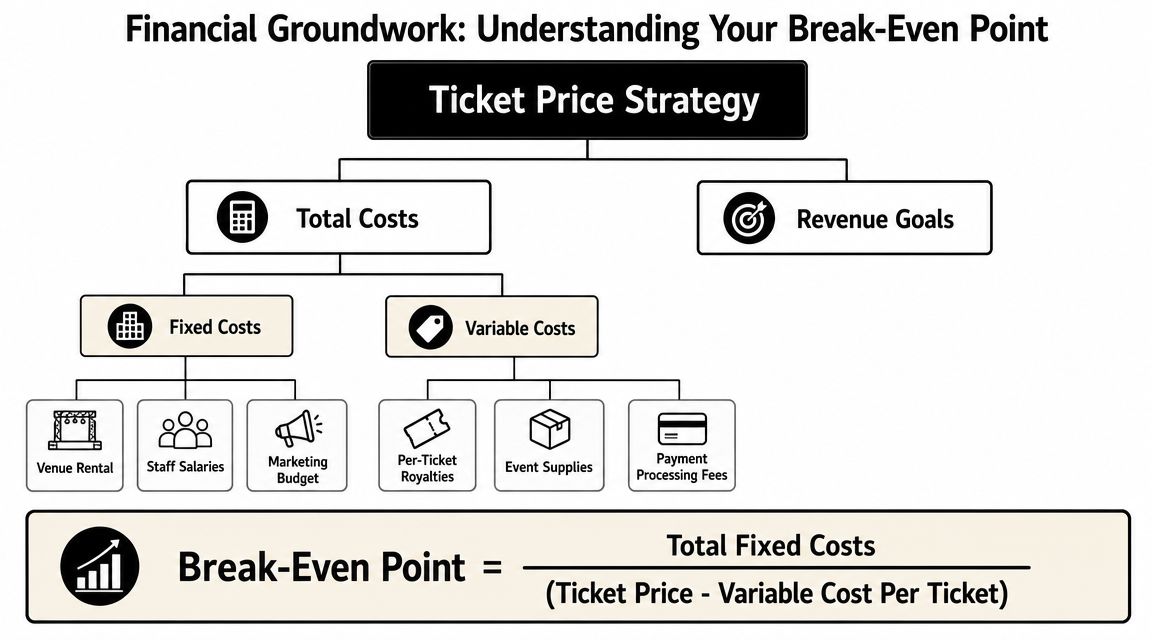
A useful way to clean this up is to split your budget into two buckets:
- Fixed costs: Venue, core staffing, entertainment, platform setup, security, baseline marketing.
- Variable costs: Costs that rise as attendance rises, such as catering per attendee, ticket fulfillment materials, or attendee packs.
If your team needs a clearer finance lens for those variable line items, Cost of Goods Sold explained is a good primer because it helps non-finance planners separate event overhead from per-attendee delivery costs.
Turn break-even into a usable floor price
Once your costs are organized, forecast ticket volume conservatively. Not optimistically. Conservatively.
That break-even calculation gives you the minimum viable average ticket revenue. It is not automatically your public ticket price. It is your baseline. From there, you decide how much of the event will be funded through standard admission, how much through premium access, and whether certain tiers can intentionally sit lower because higher-margin inventory offsets them.
For lean teams, simplicity helps. Start by asking:
- Which costs must be covered even if sales are slower than hoped?
- Which attendee-facing extras should be optional rather than baked into every ticket?
- Which inventory can carry higher margin because the value is distinct?
A pricing model becomes much easier to defend when every tier can be traced back to either cost coverage or a specific value upgrade.
This is also the point where many organizers move from a single flat ticket to a tiered structure. Not for their advanced appearance, but because they let you recover costs earlier and hold back higher-value inventory for later buyers.
If you're building the event budget and ticket logic in a lightweight workflow, a usage-based setup can keep the mechanics manageable. For example, per-event pricing for ticket operations fits teams that don't want to commit to a large software rollout before they know event volume.
The biggest mistake here is emotional pricing. If your number is based on what feels sellable, you'll second-guess it every time registrations slow down. If it's based on real costs and a credible sales forecast, you can adjust from a position of control.
Choosing Your Core Ticket Pricing Models
A planner opens sales with six ticket types, three promo paths, and a VIP tier that no one on the check-in team can explain. Buyers hesitate, support inbox volume climbs, and the front gate turns into a pricing dispute. The model looked smart in a spreadsheet. It failed in operations.
That is the fundamental test for a pricing model. It has to sell well, hold up under basic reporting, and stay easy to validate at the door if you're running on lighter systems instead of a custom enterprise stack.
How the main models differ
Choose the model your team can execute.
| Model | Description | Best For | Key Consideration |
|---|---|---|---|
| Flat pricing | One standard ticket price for the core experience | Simple workshops, local events, internal events | Easy to explain, but gives you little room to price for different levels of demand or access |
| Early-bird pricing | Lower price for buyers who commit before a clear cutoff | Conferences, launches, events needing early commitment | Deadline rules have to be enforced cleanly in the ticketing setup |
| Tiered pricing | Several ticket levels or timed batches with rising prices | Festivals, conferences, demand that builds over time | Too many tiers create comparison fatigue and more room for fulfillment mistakes |
| Bundled pricing | Packages for groups, multi-session access, or add-ons | Team attendance, multi-day programs, hybrid offers | Bundle logic needs to match how tickets will be issued, transferred, and scanned |
| Dynamic pricing | Prices change with demand, timing, or inventory pressure | Large-scale entertainment, sports, high-variance demand | Requires tight inventory control, clear buyer communication, and frequent monitoring |
Flat pricing works when the event experience is uniform and the audience expects a straightforward purchase. It breaks down once meaningful differences appear in timing, seating, access, or attendee intent. If some buyers want basic entry and others want reserved seating, workshop access, or hospitality, one price usually leaves money behind or makes the standard ticket feel expensive.
Early-bird and tiered pricing are often the safest starting point for first-time planners because they solve two practical problems at once. They reward early commitment and create a reason to buy now rather than later. They also stay manageable in smaller ticketing setups, where every extra rule adds another chance for a coding error, a broken checkout condition, or a gate-side exception.
Bundling deserves more attention than it usually gets. It is not just a discount tool. It is a packaging decision. If a meaningful share of your audience buys in pairs, teams, or session blocks, group ticket sales strategies for events can raise order value while reducing purchase friction.
Dynamic pricing can improve revenue, but it is easy to misuse. Large entertainment brands can support constant price changes because they have stronger demand signals, larger audiences, and dedicated revenue teams. Smaller organizers often copy the surface tactic without the operating discipline behind it. The result is buyer confusion, refund pressure, and staff who cannot explain why one attendee paid more than another for what looks like the same ticket.
A useful lesson from software pricing applies here too. aligning revenue with value in SaaS explains why buyers accept pricing more readily when it maps to actual access or usage. Event pricing follows the same logic. People resist arbitrary complexity. They will often accept higher prices when the extra value is visible and easy to verify.
What usually works and what usually fails
In practice, a small number of models do most of the work well.
What tends to work:
- A real early-bird offer: Best when the cutoff date is firm, the savings are noticeable, and the system switches pricing automatically.
- Two to four clear ticket paths: Usually enough to separate standard access from premium access, member pricing, or timed price increases.
- Bundles built around fulfillment reality: Team passes, table packages, and multi-day access work best when transfer rules, attendee collection, and check-in flow are already defined.
- Premium tiers with operational backing: Fast entry, reserved seating, lounge access, or hosted extras need to be visible on the ticket and easy for staff to honor.
What often fails:
- Minor variations between tiers: If buyers need to study a comparison chart to see the difference, conversion usually drops.
- Premium pricing with vague benefits: "Enhanced experience" is not a sellable offer. Reserved front rows and private networking windows are.
- Manual pricing exceptions: If staff are editing orders one by one, the model is too fragile.
- Bundles that break at the gate: Group packages sound good until no one knows whether one buyer can distribute tickets, rename attendees, or transfer access after purchase.
One rule keeps teams out of trouble. Every ticket type should answer three questions clearly: what the buyer gets, how the system records it, and how staff verify it on event day.
If those answers are weak, simplify the model before launch. A restrained structure usually earns less praise in planning meetings and causes fewer problems where it counts. Checkout, reconciliation, customer support, and entry.
Segmenting Your Audience and Justifying Value
Pricing gets easier when you stop asking, "What should the ticket cost?" and start asking, "Who is this ticket for?"
Different buyers don't evaluate the same event in the same way. A returning attendee may care about speed, familiarity, and access. A first-time buyer may need a lower-friction entry point. A sponsor guest or executive delegate may care less about price and more about convenience, seating, or exclusive moments that reduce hassle.
Build segments from behavior, not assumptions
The strongest segments are behavioral. Start with what people do, not what you assume about them.
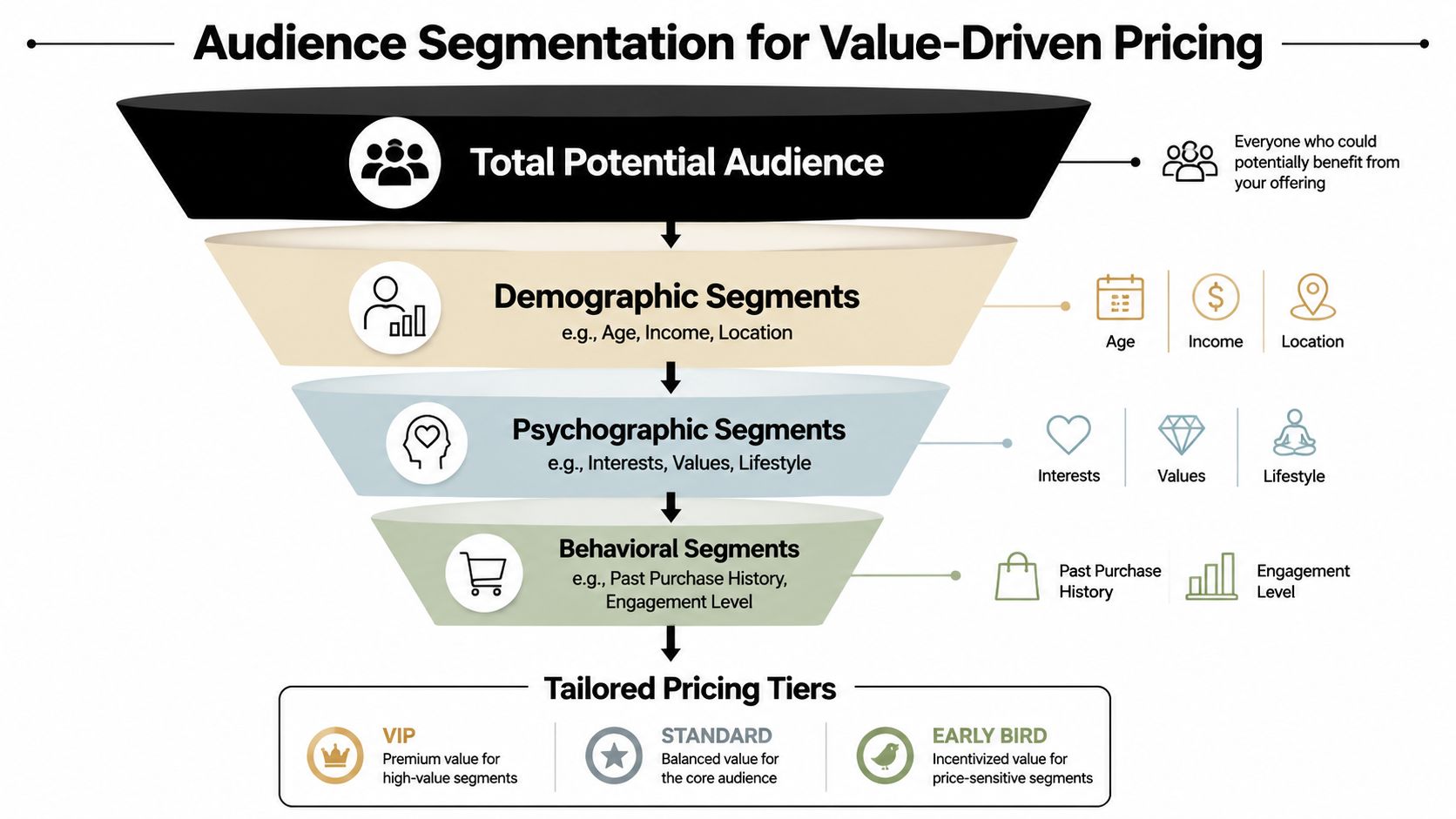
Useful segmentation signals include:
- Purchase timing: Early buyers, late deciders, last-minute registrants.
- Attendance history: Returning guests, referral groups, alumni, members.
- Use case: Individual attendee, team booking, sponsor invitee, speaker guest.
- Access preference: Core admission only, premium networking, workshop-heavy participation.
This is one place where group behavior matters more than planners expect. If a meaningful share of your audience attends with colleagues or friends, your pricing structure should reflect that. A practical reference point is group ticket sales planning, especially when one buyer is registering several attendees with different names, permissions, or arrival times.
For high-ticket and value-based pricing, experts recommend identifying the features that justify a higher price, such as exclusive access or premium support, and then restructuring offers into tiers. They also recommend validating success with metrics like customer acquisition cost and conversion rate, as described in Beanstalk Consulting's guide to high-ticket pricing.
Make every upgrade easy to explain
A premium tier should never rely on the phrase "enhanced experience" alone. Buyers need to understand what changes when they pay more.
Use value levers people can picture:
- Access: VIP lounge, speaker meet-and-greet, private networking block, premium session access
- Convenience: Faster check-in, reserved seating, flexible entry, concierge support
- Content: Workshop recordings, downloadable materials, post-event resources
- Exclusivity: Smaller-room sessions, capped roundtables, backstage or hosted experiences
This short walkthrough is useful if you're shaping tier logic around buyer psychology and perceived value:
A simple test helps here. If your team had to explain the difference between Standard and Premium in one sentence at a registration desk, could they do it cleanly? If not, the value isn't packaged tightly enough yet.
Buyers don't resent higher prices when the upgrade feels concrete, relevant, and easy to compare.
The mistake most planners make is adding perks they can deliver, rather than perks the audience values. Extra swag rarely supports a meaningful price jump on its own. Better access, less friction, and clearer outcomes usually do.
Testing and Forecasting Your Pricing Strategy
A planner opens registration for a 500-person event on a Friday. By Monday, early-bird tickets are half gone, the premium tier has barely moved, and the inbox already has refund questions about what each pass includes. That is not a pricing failure yet. It is the point where pricing becomes an operating decision instead of a spreadsheet exercise.
A ticket price is a working assumption until real buyers react to it. The goal is not to defend the first number your team picked. The goal is to find a structure that sells at the pace you need, attracts the right mix of attendees, and does not create confusion your team has to clean up later at check-in or in support.
Treat your launch price as a test, not a verdict
Start with a controlled version of your plan. For most organizers, that means releasing a limited set of tiers and testing one variable at a time across small audience groups. Change the deadline, the bundle, or the price point. Do not change all three in the same test or you will have no clean read on what affected demand.
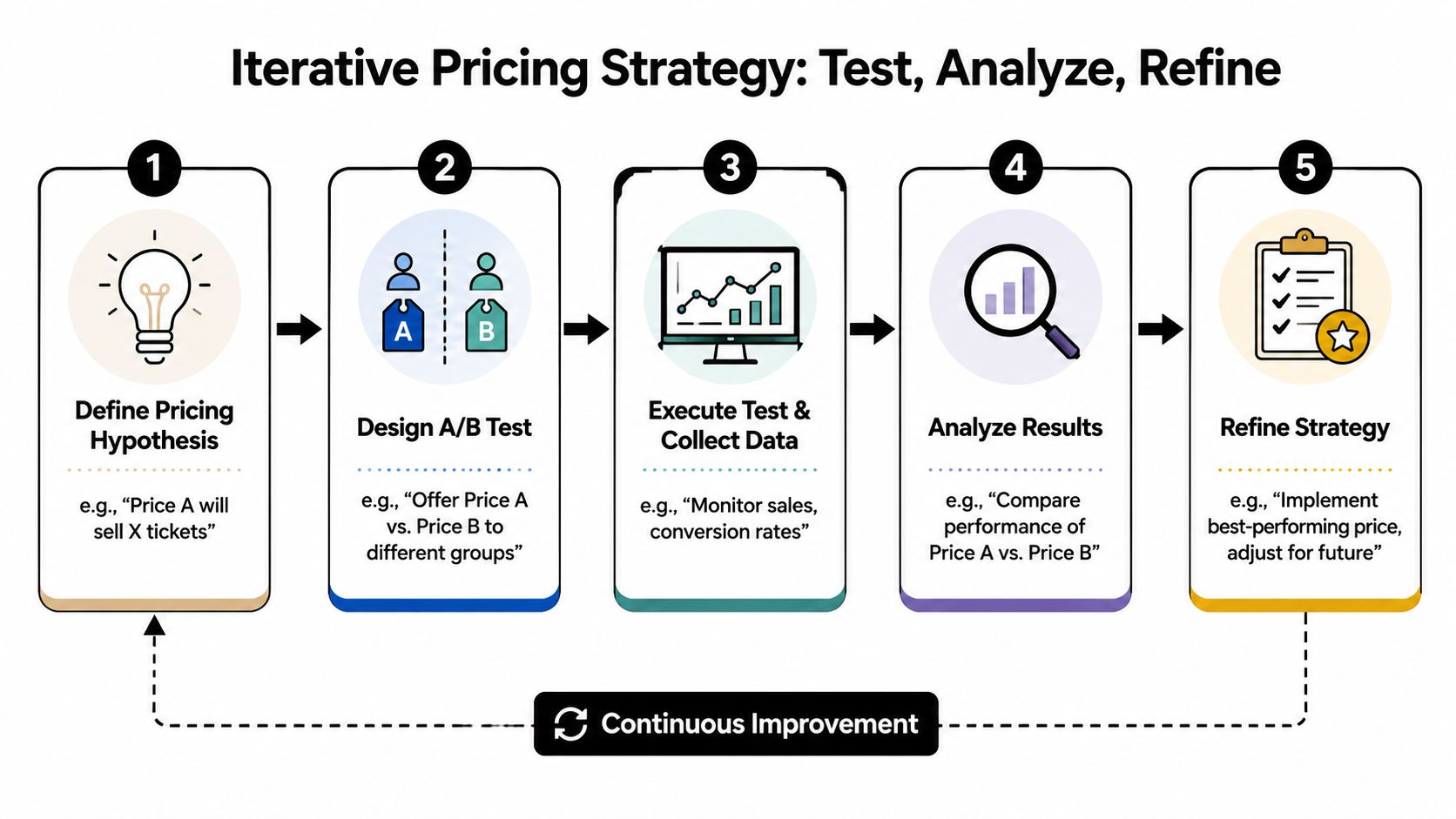
A simple setup works well:
- Send one audience segment to an early-bird offer with a firm cutoff date.
- Send another segment to a package with a different value mix.
- Track which offer converts faster and which one creates fewer support questions.
- Roll out the stronger option more broadly.
This does not require enterprise tooling. Separate registration links, segmented email sends, promo codes, and a disciplined spreadsheet can be enough if your team labels everything clearly and reviews results weekly.
The operational detail matters here. If you test a bundle that includes workshop access, your sales result only means something if your team can later verify workshop entitlement at the door. If you test family packs, group passes, or timed entry, make sure the same structure can be supported by your registration flow and on-site process. Organizers using lighter systems should review their event logistics planning process before adding test offers that create complicated fulfillment rules.
Teams that want a more adaptive testing model can learn from how multi-armed bandit testing works. The practical lesson is straightforward. You do not always need to wait for a long fixed test to finish before shifting more traffic to the offer that is already outperforming.
Forecast demand using live sales behavior
Forecasting gets better once tickets are live, because buyer behavior exposes problems your planning model cannot. Watch signals that show both demand quality and execution quality.
Track these closely:
- Conversion rate: Are visitors buying, or abandoning the page after seeing the offer?
- Average order value: Are bundles and upgrades increasing revenue per order?
- Refund and exchange requests: These often reveal confusing tier logic before complaints become widespread.
- Sales velocity by tier: Which ticket classes are moving on pace, and which are stalling?
Review those signals against your capacity and timing, not in isolation. If the cheapest tier sells out immediately, you may have left money on the table or released too little inventory. If a premium tier lags while standard admission sells steadily, the problem may be weak packaging, poor naming, or benefits that staff cannot explain clearly.
The best pricing tests answer two questions at once. Which option sold better, and which option created fewer downstream problems?
That second question gets ignored too often. A tier that converts well but triggers refund requests, transfer requests, and on-site disputes may still be the weaker choice. Good forecasting accounts for revenue, buyer clarity, staffing load, and access control. That is how pricing theory holds up in the actual conditions of selling and validating tickets with flexible systems.
Implementing Pricing and Managing Operations
A pricing strategy can look smart in a deck and still fail at the registration table.
Planners experience the gap between theory and operations. The more ticket types you create, the more rules your team has to enforce. That affects the registration page, payment flow, attendee communications, refund handling, QR code permissions, badge printing, and what happens when someone shows up with the wrong entitlement on-site.
Your pricing only works if your system can enforce it
Every ticket type creates an operational promise. If you sell VIP entry, your check-in team needs to identify VIPs fast. If you sell a workshop add-on, your scanner or staff list has to distinguish workshop access from general admission. If you sell multi-day passes, your system needs to know whether day one entry should still be valid on day two.
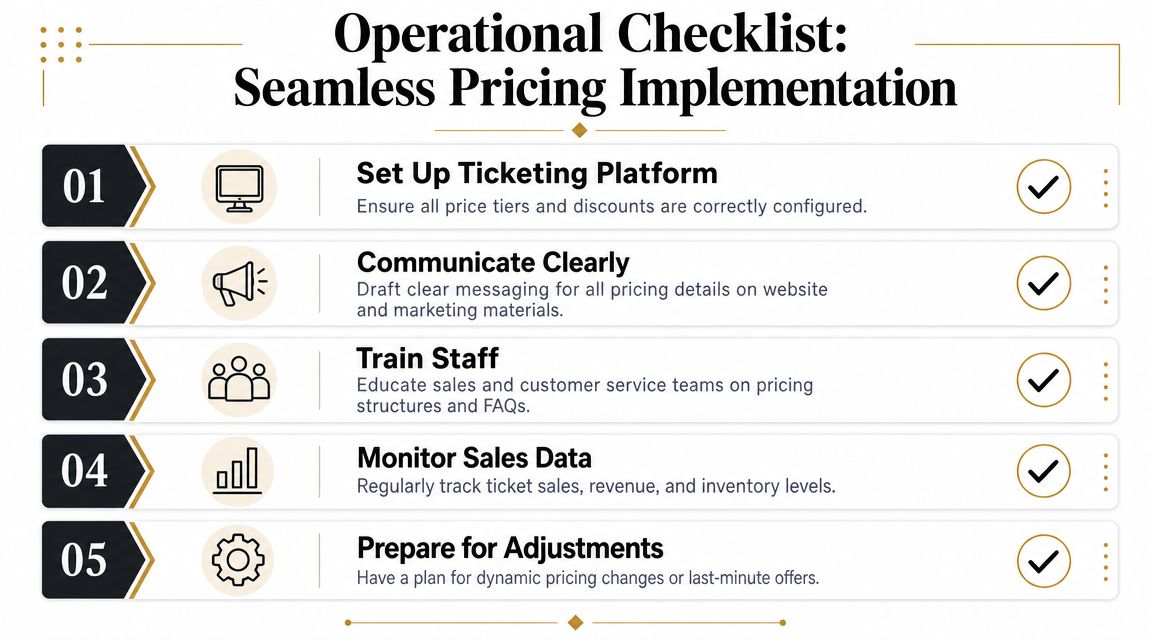
For flexible, non-enterprise setups, the biggest risk isn't usually pricing creativity. It's enforcement gaps. Teams build a clever structure in Stripe, Eventbrite, Google Forms, or a custom sheet, then discover the door process can't validate the entitlements cleanly.
A workable setup should support:
- Ticket classes tied to permissions: Not just names, but actual access rules.
- Clear attendee data fields: Session, zone, date, bundle type, host group, discount source.
- Fast validation at entry: Staff should know immediately whether the ticket is valid for that line.
- Simple exception handling: Transfers, duplicates, manual approvals, late upgrades.
When teams want to keep operations inside Google Workspace, one option is Darkaa's event logistics workflow tools. Darkaa works with Google Sheets and Forms for QR code ticketing and check-in, including multiple days, sessions, zones, and access permissions. That's useful when the pricing structure creates different entitlements but the team still wants a lightweight operating setup.
Keep trust intact while prices change
Price changes don't damage trust. Poor communication does.
If you use early-bird, tiered, or dynamic logic, buyers need to understand three things clearly:
- What this ticket includes
- Why this price applies now
- What changes later, if anything
Hidden fees create friction fast. So do vague labels like "premium" or "priority" with no visible benefit. Clear names beat marketing language every time. "Conference Pass plus Workshop Access" is better than "Pro Experience" unless your audience already knows what that means.
Discounts need rules too. Promo codes should have owners, expiration logic, and purpose. Without that, teams accidentally train buyers to delay purchases or ask support for exceptions one by one.
If a buyer needs customer support to understand a ticket type, the pricing architecture is too complicated.
Price for access rights, not just headcount
Event-tech guidance increasingly emphasizes pricing for access complexity, not just attendance volume. That includes modular pricing for premium sessions, multi-day access, or specific zones, reflecting the shift toward buyers paying for what they consume, as discussed in Airmeet's guide to event ticket pricing for in-person, virtual, and hybrid formats.
Many modern events need a different mindset. A conference isn't just a seat count. It may include main-stage access, breakout eligibility, recordings, networking sessions, exhibitor zones, meal permissions, and day-specific credentials. A festival may have camping, parking, backstage, and VIP areas. A university event may require different rights for graduates, guests, staff, and vendors.
When you price access cleanly, operations get easier because each product maps to a real permission set. When you price loosely, staff end up improvising on-site.
The practical standard is simple. Sell only the complexity you can explain, fulfill, and verify without confusion.
If you're building a ticket pricing strategy and want a system that can handle both simple guest lists and more complex access rules without forcing your team into a heavy new platform, Darkaa is worth a look. It turns Google Sheets and Forms into a QR code ticketing and check-in workflow, which is useful for planners who need to price, distribute, and validate tickets across sessions, zones, and event days while keeping operations manageable.