You're probably looking at your Saturday plans and trying to decide whether Venice Summer Fest is the kind of event where you can just show up and wander, or the kind where a little planning saves you from a sweaty, crowded, where-do-we-go-now afternoon. It's definitely the second kind.
That's not a bad thing. It's part of why Venice Summer Fest works. It isn't a tucked-away venue with one entrance and one main stage. It's a spread-out street festival with music, vendors, workshops, food, and enough movement that the day goes better when you treat it like a neighborhood takeover instead of a single-stop concert.
If you want the inside scoop on when to arrive, how to move through the festival without backtracking all day, what to do if you're coming with kids or someone with mobility needs, and what organizers can learn from an event like this, this guide will save you time.
Table of Contents
- Your Ultimate Guide to Venice Summer Fest
- What Is the Venice Summer Fest
- 2026 Dates Schedule and Lineup Highlights
- Getting There and Navigating the Festival
- Essential Attendee Tips for a Great Day
- For Organizers A Festival Management Checklist
- Frequently Asked Questions
Your Ultimate Guide to Venice Summer Fest
A good day at Venice Summer Fest usually starts before you ever hear the first band. You pick a meet-up point that's easy to remember. You wear shoes you'd trust for a long stretch on pavement. You accept that if you drive straight to the middle of the action and hope for an easy parking spot, you're setting yourself up for frustration.
That's the rhythm of this event. The fun is real, but so is the scale. Venice Summer Fest has grown into the kind of Westside outing where people come for different reasons and all end up sharing the same blocks. Some are there for the bands, some for the local brands and artists, some for the car show, and some just want a free all-ages day outside that feels distinctly Los Angeles.
Practical rule: Street festivals reward people who think in zones, not in single destinations.
The best way to enjoy it is to arrive with a loose plan and enough flexibility to follow what catches your attention. That means knowing the footprint, understanding the timing, and making smart choices about entry, breaks, and where to regroup if your crew splits up.
If you've only seen promo posts about the vibe, this guide fills in the part many visitors require. How to get there. How to move around. How to think about accessibility when the official info is thin. How to stay comfortable during the busiest part of the day. And if you're an organizer, how to borrow the good operational lessons from an event like this without copying its problems.
What Is the Venice Summer Fest
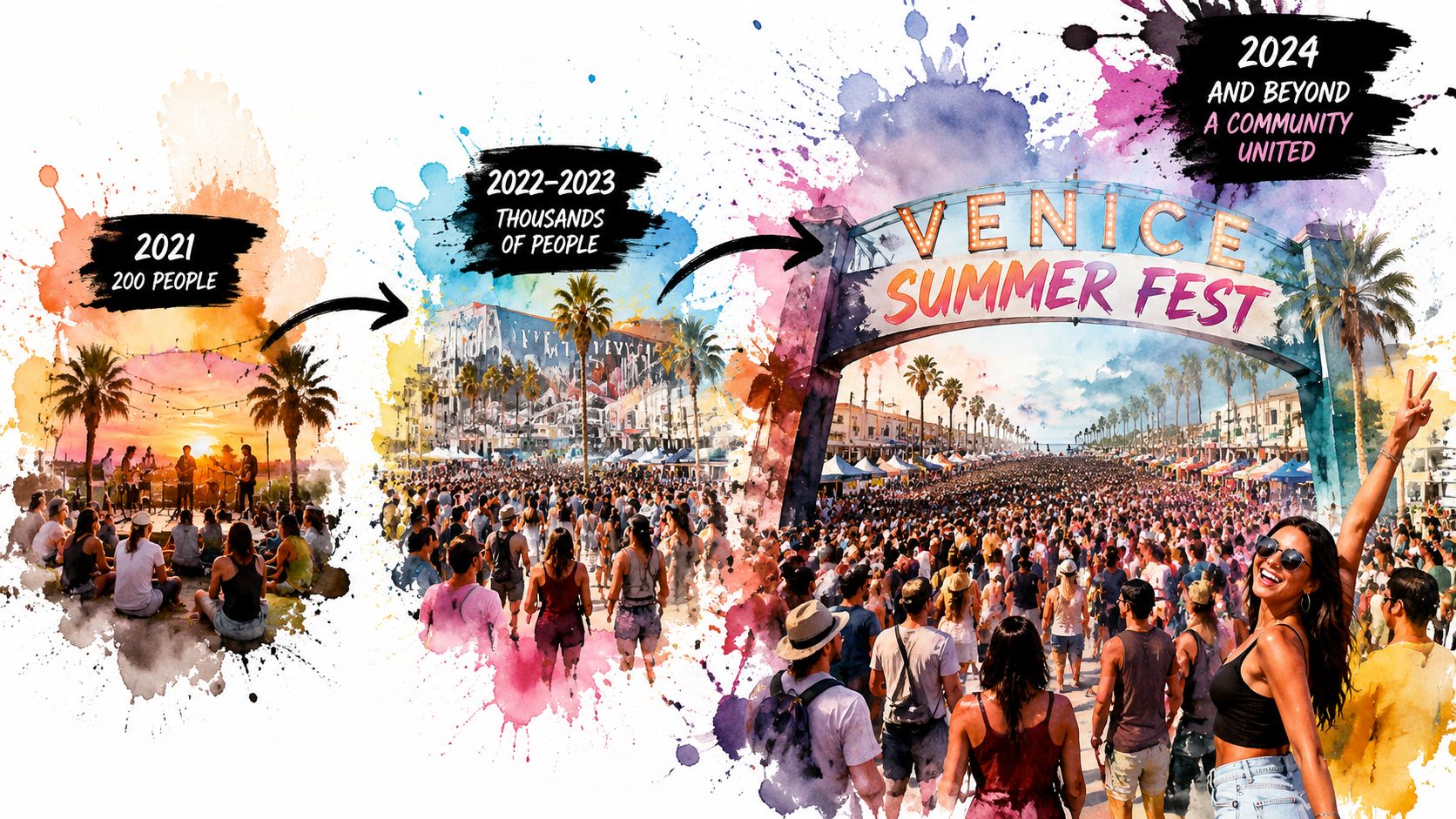
Venice Summer Fest started small and turned into something much more ambitious. It began in November 2021 with 200 participants and has since grown into a four-block event on Venice Blvd, with the 2026 edition projected to feature over 400 local artists and brands, a 100-fold increase in artist participation, according to the Santa Monica Daily Press report on Venice Fest's growth.
Why this festival feels bigger than a market
That growth matters because it explains the personality of the event. Venice Summer Fest doesn't feel like a craft fair that added a stage. It feels like a local creative scene that kept scaling up until it became a street takeover.
When a festival grows from a neighborhood gathering into something expected to draw thousands, the experience changes in a few important ways. You get more variety and more energy, but you also get more decision points. Where to start. When to stop and eat. Which stage to prioritize. Whether to linger in a vendor-heavy stretch or keep moving before it gets packed.
The upside is that the event still carries a local identity. Even at a bigger scale, the draw is still local artists, designers, brands, music, and hands-on creative activity. That's a different feel from a corporate outdoor festival where every booth looks interchangeable.
Venice Summer Fest works best when you treat it like a neighborhood cultural crawl with live music, not a single-headliner event.
What you'll actually find on the ground
The event's mix is broad enough that most groups can split up for a while without anyone feeling stranded. Expect a blend of shopping, browsing, music, and activity rather than one central attraction that absorbs the whole crowd.
Here's the practical read on the experience:
- Music pulls people along the route. With multiple stages in play, the sound itself helps you orient where the busiest energy is.
- Vendors create natural bottlenecks. That's great for discovery, less great if your whole group stops in the middle of the walkway.
- Workshops change the pace. They give people a reason to pause that isn't just shopping or waiting for the next set.
- The car show adds a different audience pocket. Not everyone is there for the same thing, which is part of why the festival feels layered.
If you're new to Venice Summer Fest, the key is to expect a moving environment. You won't absorb it all from one spot, and that's exactly the point.
2026 Dates Schedule and Lineup Highlights
If you only lock in three details before you leave home, make them the date, the hours, and the fact that this is a free event. The rest of the day gets easier once those basics are clear.
The key details to lock in first
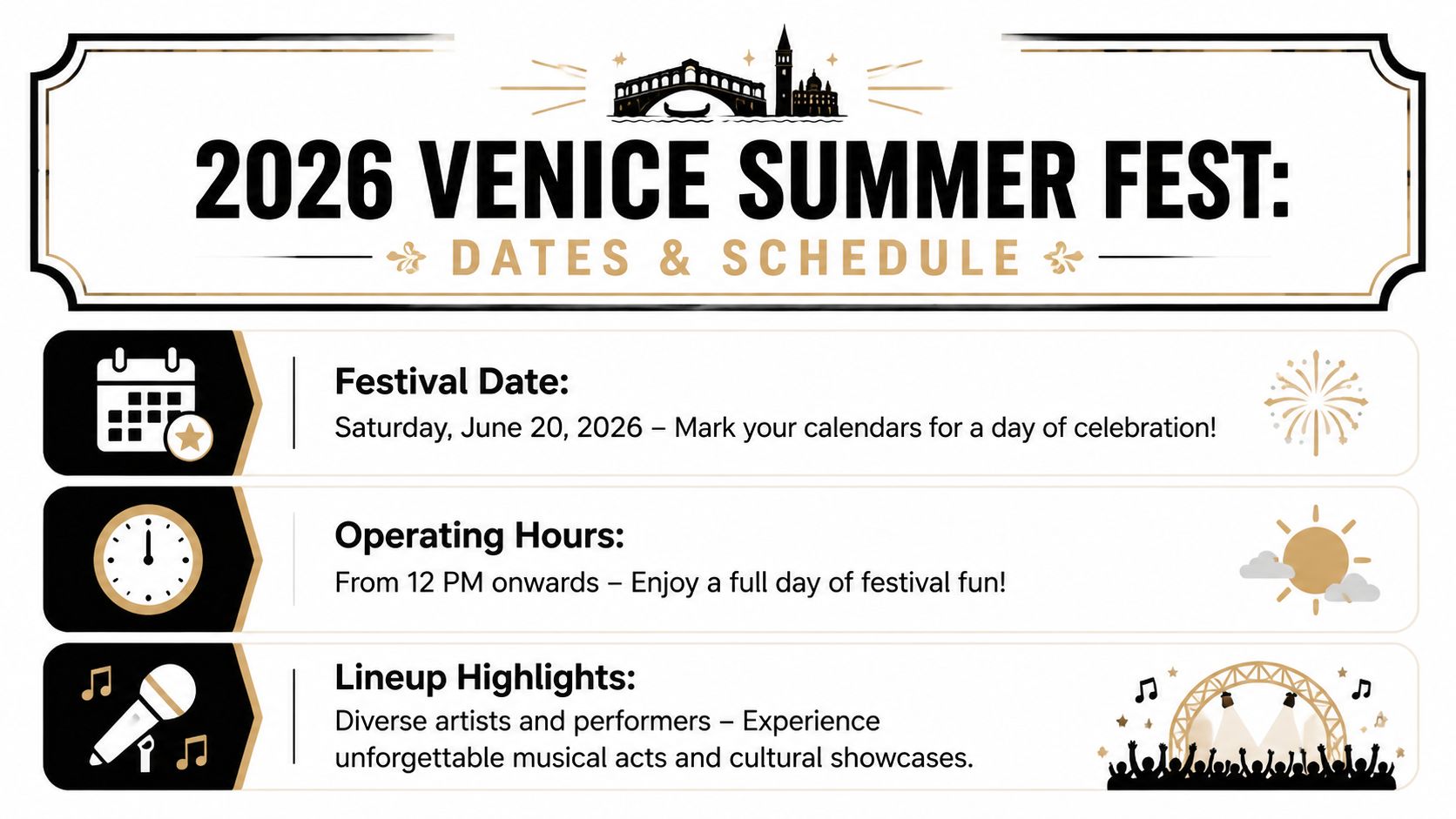
The festival is scheduled for Saturday, June 20, 2026, from 12:00 PM to 8:00 PM PDT. It's promoted as a free, all-ages event with more than two dozen bands, three stages, a classic car show, and art workshops, as listed on the official Venice Fest event website.
That timing gives you options. You can show up close to opening if you want easier browsing and a calmer first lap. Or you can come later when the streets feel fuller and the music side of the event is likely carrying more momentum. Neither is better across the board. It depends on your tolerance for crowds and your reason for going.
A quick planner's view helps:
| Focus | Best approach |
|---|---|
| Shopping and browsing | Arrive earlier and make one clean pass before you settle anywhere |
| Music-first day | Check stage activity soon after arrival and choose one anchor area |
| Family outing | Start earlier, leave yourself room for breaks |
| Group hang | Set a meet-up point before anyone gets distracted |
A preview clip helps if you want a feel for the event atmosphere before you go.
How to plan your day around the programming
A common mistake is trying to do the day in a rigid sequence. That usually fails at street festivals because the draw is spread out. One stage gets busy. A food line appears. Someone wants to stop at a vendor row. You hear a set from half a block away and change direction.
A better plan is to build your day around two anchors and let the rest float. For example:
- Pick one anchor activity early. That might be a first stage, the car show, or a workshop.
- Do one full walk-through before settling in. You'll make smarter choices after seeing the layout.
- Leave one hour unplanned. That's the time you'll use best once you're there.
What doesn't work is arriving late, hungry, with no meeting point, then stopping at the first crowded section and never seeing the rest of the festival. Venice Summer Fest is broad enough that a little structure goes a long way.
Getting There and Navigating the Festival
Getting to Venice Summer Fest is half logistics, half expectations management. It's a street festival, not a venue with a giant parking lot and obvious front gate. If you plan for flexibility, you'll feel smart. If you plan for convenience at the exact center of the event, you'll probably waste time.
Use the right arrival strategy
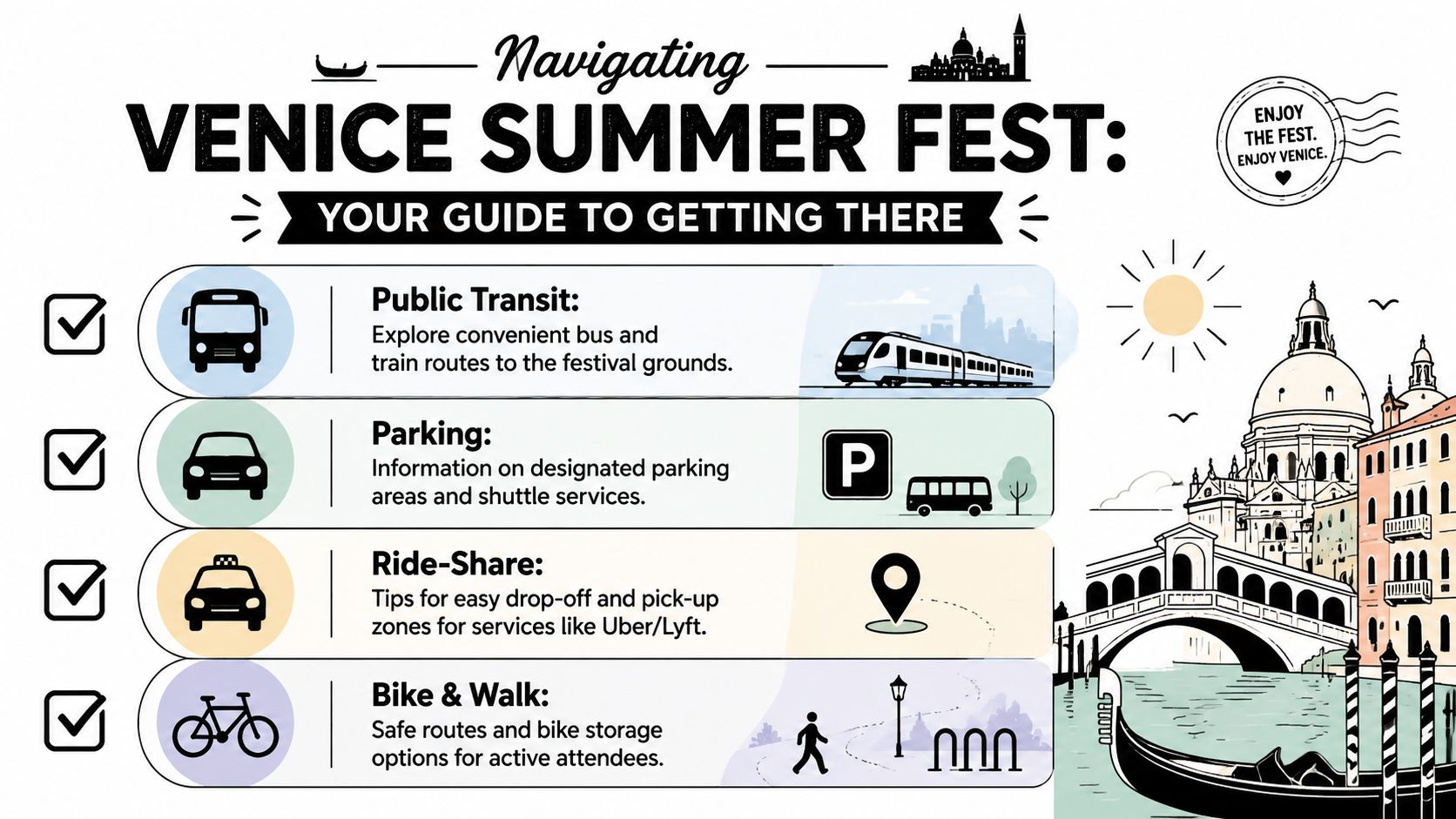
The navigational anchor is 12257 Venice Blvd, Los Angeles, CA 90066, and the festival footprint runs along a full street closure from Centinela to Inglewood Blvd across four blocks, according to the event listing and street closure details on Ticket Tailor.
That setup changes how you should arrive.
- Driving works best if you're willing to park outside the busiest stretch. Don't aim for the center. Aim for a manageable walk.
- Rideshare is easier if you choose a pickup and drop-off point away from the densest block. Your feet will save you more time than a car stuck near barriers.
- Transit can be a strong option if you want to skip parking stress. Check your route before you leave, especially for the return trip.
- Walking or biking makes the most sense if you already live nearby. You avoid the arrival headache altogether.
If you run live events yourself, the festival footprint is also a good reminder of why QR code tickets for concerts and festivals matter most when entrances, staff positions, and access points are spread over a long site rather than concentrated at one gate.
How to move through a four-block festival
The festival environment prompts feelings of either relaxation or being oddly lost. A linear festival sounds simple, but it creates small navigation problems all day. Friends drift ahead. One side of the street feels busier than the other. A stage stop turns into a twenty-minute split in the group.
The easiest method is to treat the route in sections rather than trying to remember every booth.
Try this:
- Start with a top-to-bottom pass. Don't shop heavily on lap one unless something is time-sensitive.
- Use landmarks, not vague phrases. “Near the middle” is useless. “By the stage on the west side” is better.
- Pick one regrouping point before anyone wanders. Food areas and stage edges are bad choices if they're crowded.
- Notice your exits while it's calm. Leaving gets harder when everyone decides to leave at once.
Walk the full footprint once before you commit to a home base. You'll avoid the classic mistake of spending two hours in the first busy block and missing half the event.
What doesn't work is stopping every ten feet on your first pass, then realizing you have no idea where the next stage or your friends are. Venice Summer Fest is much more enjoyable when you map it with your feet early.
Essential Attendee Tips for a Great Day
The official festival materials tell you why the event is appealing. They don't tell you enough about how to handle it comfortably if you're coming with a stroller, managing limited mobility, or trying to avoid the most congested periods. That gap matters more here than it would at a single indoor venue.
Accessibility takes extra planning here
Official resources for Venice Summer Fest don't provide detailed public guidance on accessibility for attendees with limited mobility, and they also don't spell out much about navigation support in crowded areas. For a street event expected to draw thousands, that's a meaningful information gap.
If accessibility is a real factor for you or someone in your group, don't treat this as a show-up-and-see situation. Plan conservatively.
A few practical choices help:
- Arrive earlier if possible. Early movement is usually easier than maneuvering through dense vendor lines later.
- Use the outer edge of the crowd flow. The middle of a booth-heavy corridor is usually the hardest path for wheelchairs, walkers, and strollers.
- Build in seated breaks off the main stream. Don't wait until someone is already tired or overloaded.
- Contact the organizers before event day if you need specifics. Ask about parking, curb access, restroom access, and any quieter zones.
If you're trying to coordinate with friends in advance, a simple shared ticket or RSVP workflow can help everyone keep the same entry details and timing. Even for free events, tools built around QR code RSVPs and event entry planning make group coordination cleaner.
Crowd safety works best when your group agrees on a plan
The other missing piece is public detail on crowd safety and emergency protocols. That doesn't mean the event is unsafe. It means attendees should handle a few basics themselves instead of assuming every answer will be obvious on site.
Use a lightweight group plan:
- Choose a meeting point before you enter the busiest area.
- Agree on a fallback if phones die or service gets spotty.
- Identify staff, security, or info points as you walk in.
- If one area feels jammed, keep moving. Street festivals almost always open up a block away.
If you lose your group, don't stand still in the narrowest part of the crowd and start texting. Move to the edge first, then reconnect.
Parents should think the same way. Kids can get distracted fast in a free all-ages environment with music, cars, food, and vendors. Put the reunion plan in place before they need it.
What to bring and what to skip
This is the part that determines whether you feel good at hour two or hour six.
Bring the basics that solve real festival problems:
- Comfortable shoes: You'll cover more ground than you expect on pavement.
- Sun protection: Hat, sunglasses, and sunscreen earn their keep fast.
- Water: A refillable bottle is practical if you'll be there for a long stretch.
- Portable charger: Especially if your group is splitting up.
- Small bag: Big enough for essentials, not so big it becomes annoying in crowds.
Skip anything that makes movement harder.
A bulky bag, shoes you only tolerate for dinner, or a vague “we'll figure it out” plan are all common mistakes. Venice Summer Fest is most fun when you stay light, stay mobile, and leave room to adapt.
For Organizers A Festival Management Checklist
For event professionals, Venice Summer Fest is a useful model because it shows both the appeal and the pressure points of a free public festival. A broad footprint, mixed programming, and a large open audience can create fantastic energy. They can also expose every weak spot in your operations plan.
Build the attendee flow before event day
A common mistake in free festivals is assuming that “no ticket required” means “no list required.” That usually backfires. Even if the public area is open access, you still need structure around RSVPs, vendors, performers, sponsors, media, volunteers, and any restricted backstage or load-in zones.
Start with a checklist that separates audience flow from staff flow:
- Public RSVP layer: Optional or required, depending on your model
- Credential groups: Vendor, artist, crew, guest, sponsor, press
- Check-in logic: Who gets scanned, who gets wristbanded, who gets visual access only
- Incident backup: Printed lists, zone leads, and offline fallback
For temporary structures, weather cover, and sheltered activation areas, organizers planning a similar build can review Premier Marquee Hire for festival events as a practical example of the infrastructure thinking that often gets under-scoped in early planning.
Separate public entry from controlled access
Open festivals often fail when organizers use one process for everyone. The public may not need hard-gate admission, but controlled groups absolutely need clean access logic. Vendors shouldn't queue with guests. Artists shouldn't depend on a volunteer scrolling through a phone note. Crew access shouldn't collapse because a single device loses signal.
What works better is a layered setup:
| Zone or group | Best control method |
|---|---|
| Public festival area | Light-touch entry, signage, and visible info points |
| Vendor and exhibitor areas | Pre-issued credentials and fast scan validation |
| Backstage or production | Role-based access and separate check positions |
| VIP or partner areas | Distinct ticket types with permission rules |
For teams mapping these flows, event logistics planning for multi-zone check-in is the kind of operational work that should happen before creative teams lock the final site plan.
Use simple tools your staff will actually learn fast
The smartest event systems are usually the ones temporary staff can learn quickly. For Google Workspace teams, that often means avoiding one more standalone dashboard and building from tools staff already understand.
A practical stack for a festival like this usually includes:
- QR code attendance for Google Forms when you need lightweight RSVP collection without extra friction
- QR code ticket check-in for Sheets when access rules differ by zone, day, or role
- QR code tickets for Google Sheets when you need branded ticket distribution tied directly to your working list
The trade-off is straightforward. Complex event operations need precision, but the people executing those operations often include volunteers, seasonal hires, and partner staff. If your system takes too long to teach, your entry lines will expose that immediately.
The best check-in process is the one your staff can run correctly under pressure, not the one that looks most impressive in a demo.
For a festival inspired by the Venice Summer Fest format, that means building for real-world conditions. Multiple access points. Outdoor connectivity issues. Different attendee types. Last-minute list changes. Zone-specific permissions. Those are operations problems first, software problems second.
Frequently Asked Questions
Can I bring my dog
Check the latest event guidance before you go. Public street festivals often attract dogs, but crowd density, heat, pavement, and noise can make the day rough on them even when they're technically allowed. If your dog doesn't handle busy environments well, leave them at home.
Is alcohol available or permitted
Look for current festival rules from the organizers before event day. Don't assume you can bring your own. Street events often have specific restrictions, service rules, or designated vendor policies.
What happens if it rains
Weather can change operations, vendor setups, and crowd behavior quickly. If conditions look uncertain, check the official event channels before leaving. Wear shoes that can handle a slick street surface either way.
Are there ATMs on site
Don't count on finding one exactly when you need it. Bring a payment method that works across vendors, and carry a small backup option in case one booth has limited payment flexibility.
Is this a good event for kids
Yes, in the sense that it's promoted as all-ages. But kids do better when adults arrive early, set a clear meeting point, and build in breaks away from the busiest clusters.
What's the smartest arrival time
That depends on your goal. If you care most about easy movement, go earlier. If you care most about peak atmosphere, go later and expect more crowding.
If you run events and want a simple way to create, send, and scan tickets without leaving Google Workspace, Darkaa is worth a look. It turns Google Sheets and Forms into a practical QR ticketing and check-in system for festivals, community events, conferences, graduations, and guest-list based entry.