$107 million in annual economic output is the number that changes how you should look at the Cincinnati Music Festival, not just as a concert weekend but as a city-scale operation with real pressure on streets, hotels, venues, and staff. The festival's official materials describe that impact on the Greater Cincinnati region, which tells you right away that CMF is bigger than a lineup poster and bigger than one stadium night. You're stepping into a weekend that moves money, traffic, and people at scale, and that affects every decision from when you leave your hotel to how organizers manage entry at the gate. Cincinnati Music Festival economic impact
Most guides stop at artists and parking. That's not enough for an event this large. People coming to the Cincinnati Music Festival need practical advice on timing, movement, comfort, and risk. Organizers need something else entirely: a realistic look at ticketing, check-in, traffic flow, and access control.
This guide handles both. If you're attending, it will help you move smarter and enjoy more of the weekend. If you run events, it will also show what a major festival teaches about logistics, especially the parts most public guides ignore.
Table of Contents
- Welcome to the Cincinnati Music Festival
- The Heart and Soul of CMF A Legacy of Black Music
- CMF 2026 Dates Lineup and How to Get Tickets
- Navigating the Venue and City Logistics
- Attendee Tips for a Safe and Fun Festival
- A Guide for Event Organizers Ticketing and Check-In
- Experience the Best of Cincinnati Music
Welcome to the Cincinnati Music Festival
The Cincinnati Music Festival sits in a category of its own. It's a live music event, a regional travel draw, a downtown traffic event, and a cultural gathering with deep roots in Black music. When one weekend can reshape hotel demand, transportation patterns, and retail activity across a major metro, you're not dealing with a casual night out.
For attendees, that scale creates a simple truth. The people who have the best experience usually aren't the ones who improvise everything. They're the ones who treat the weekend like a real operation. They know where they're entering, when they're moving, what they're carrying, and what they'll do if weather or crowds push the night off script.
For planners, CMF is a useful model because it exposes the friction points that smaller events can ignore. Entry bottlenecks. Street control. Exit sequencing. Zone-based access. Multi-venue coordination. Those are not back-office details. They shape the experience as much as the performers do.
What attendees should expect
The festival draws a crowd that comes for headline acts, shared tradition, and the broader atmosphere around downtown Cincinnati. That means your experience starts well before you reach your seat. Travel timing, pickup locations, and walking routes all matter.
A few practical expectations help:
- Expect volume: You're entering a high-demand environment with packed routes and long movement chains.
- Expect layered programming: The weekend reaches beyond the main stage experience.
- Expect trade-offs: The closer you stay to the action, the more you'll likely deal with crowds, pricing pressure, and route restrictions.
Practical rule: For a festival this large, convenience always gets purchased in advance. If you wait until day-of to decide transportation, lodging, or entry timing, you'll have fewer good options.
What organizers should notice
CMF is also a reminder that attendee-facing smoothness is usually built on invisible discipline. Strong events don't just sell tickets. They control flow. They define permissions clearly. They reduce ambiguity for guests and staff.
That's why this guide treats the Cincinnati Music Festival as both a destination and a working case study. If you love live events, you can use it to enjoy the weekend. If you produce them, you can read it as a blueprint for what large-scale operations demand.
The Heart and Soul of CMF A Legacy of Black Music
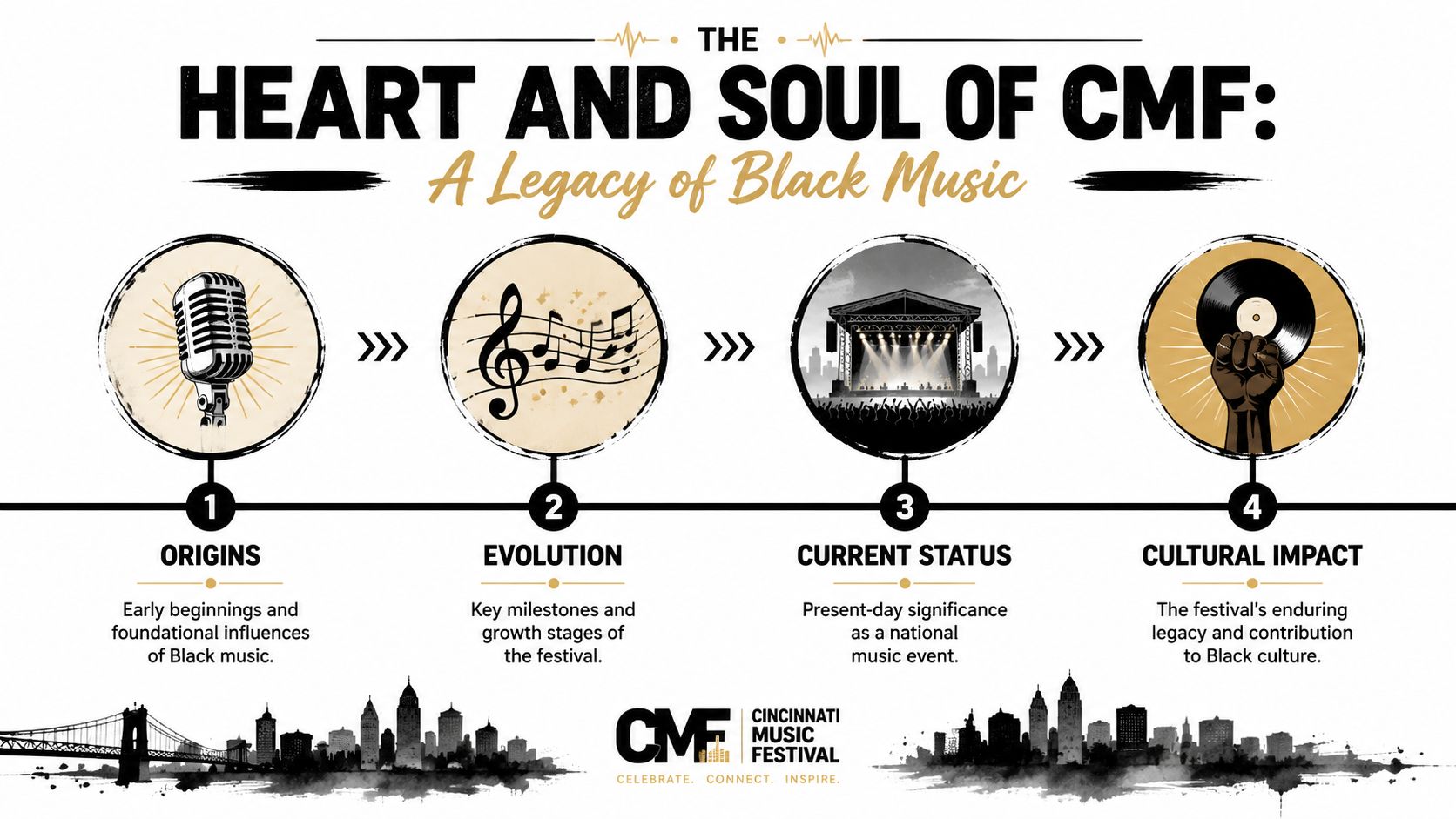
The Cincinnati Music Festival has lasted because it stands for more than one year's bill. People come back for the artists, but they also come back for the feeling of continuity. R&B, soul, jazz, and hip-hop don't sit here as disconnected genres. They show up as a living lineage, with legacy acts, hometown pride, and multigenerational attendance all folded into the same weekend.
That's part of why CMF still matters. It isn't trying to mimic every newer festival trend. It knows what it is. It serves a crowd that values performance, recognition, and cultural memory as much as novelty.
Why the festival matters
One of the strongest things about the Cincinnati Music Festival is that it connects stage programming with a broader celebration of Black culture in the city. That makes the weekend feel fuller than a standard in-and-out concert schedule. You're not only buying access to a performance. You're stepping into a tradition that people build their summer around.
You can see that in the way the event brings together different audiences. Some people come for the headliners. Some come for reunion energy. Some come because CMF is part of family routine, friend tradition, or alumni-style social rhythm. Festivals that last don't survive on lineup alone. They survive because the event becomes part of how people mark time.
The best music festivals don't just book talent. They give a community a recurring place to gather.
The broader weekend isn't equally transparent
There's also a real nuance that doesn't get enough attention. The festival promotes “professional events, speaker series, food, shopping, parties, and more,” but there's a lack of public data on registration and access for non-local attendees, which leaves open questions about how inclusive that broader cultural experience is for visitors coming in from outside the city. Weekend programming access questions for non-local attendees
That gap matters more than it seems. If you're local, you might know the social map already. You know what's open, who hosts what, which events are public, and which ones operate more like insider gatherings. If you're not local, the official promise of a wider cultural weekend can feel harder to understand.
For attendees, the practical takeaway is simple. Treat parallel events as separate planning items, not automatic add-ons to your main festival ticket. Confirm access before you build your day around them.
For organizers, this is a useful lesson in audience design. Programming can be culturally rich and still be operationally unclear. If event access, registration logic, or guest eligibility isn't obvious, outsiders often read that as exclusion, even when the intent was inclusion.
CMF 2026 Dates Lineup and How to Get Tickets
If you're searching for the Cincinnati Music Festival for one reason, it's usually this section. Dates first. Artists second. Ticket strategy third. That order matters because it helps you avoid buying emotionally and planning badly.
The 2026 festival dates and daily lineup
The 2026 Cincinnati Music Festival runs July 23 to July 25, 2026, with hip hop legends on Thursday, Charlie Wilson and Nelly on Friday, and Mary J. Blige, Trey Songz, and SWV on Saturday, according to the 2026 Cincinnati Music Festival week guide.
Here's the cleanest way to view it:
| Day | Date | Artists |
|---|---|---|
| Thursday | July 23, 2026 | Talib Kweli, DJ Spinderella, Hi-Tek, DJ Vader |
| Friday | July 24, 2026 | Charlie Wilson, Tyrese, Ledisi, Nelly |
| Saturday | July 25, 2026 | Mary J. Blige, Trey Songz, SWV, Doug E. Fresh, Slick Rick, Heatwave |
This lineup tells you a lot about the festival's identity. Thursday leans into hip-hop culture and DJ energy. Friday balances marquee nostalgia with broad crowd appeal. Saturday closes with artists that anchor the festival's reputation and pull a strong sing-along crowd.
How to buy tickets without making avoidable mistakes
For an event with this much recognition, ticket buying should be boring. That's a good thing. The more “creative” the purchase path looks, the more cautious you should be.
Use these rules:
- Start with official festival channels. The cleaner the chain of custody, the less likely you are to deal with invalid screenshots, duplicate barcodes, or mystery transfer issues.
- Decide your night before you chase your seat. Some people lock onto section location too early and end up overpaying for the wrong day.
- Check delivery format. Mobile delivery is normal, but make sure everyone in your group understands who holds what.
- Keep transfer plans simple. If one person is managing all entries, your group needs a clear meetup and arrival sequence.
A lot of ticket stress doesn't come from scarcity. It comes from messy group coordination. One person buys. Another arrives late. A third sends the wrong file. The fix is simple. Confirm names, dates, and who's carrying entry credentials before travel day.
For organizers studying this side of the business, QR code ticketing for concerts and festivals is worth reviewing because it shows how digital ticket delivery and scan-based access work when events need cleaner validation at the gate.
Buy for the experience you want, not the one you think you can improvise into later. Multi-day weekends punish vague planning.
One more practical point. Don't assume every available resale listing is functionally equal. A legitimate-looking ticket can still create entry problems if transfer rules are unclear or the buyer never receives proper control of the pass. In high-demand live events, certainty is often worth more than shaving a little off the price.
Navigating the Venue and City Logistics
Most festival frustration doesn't happen in the seat. It happens before entry and after the encore. That's where planning beats enthusiasm every time.
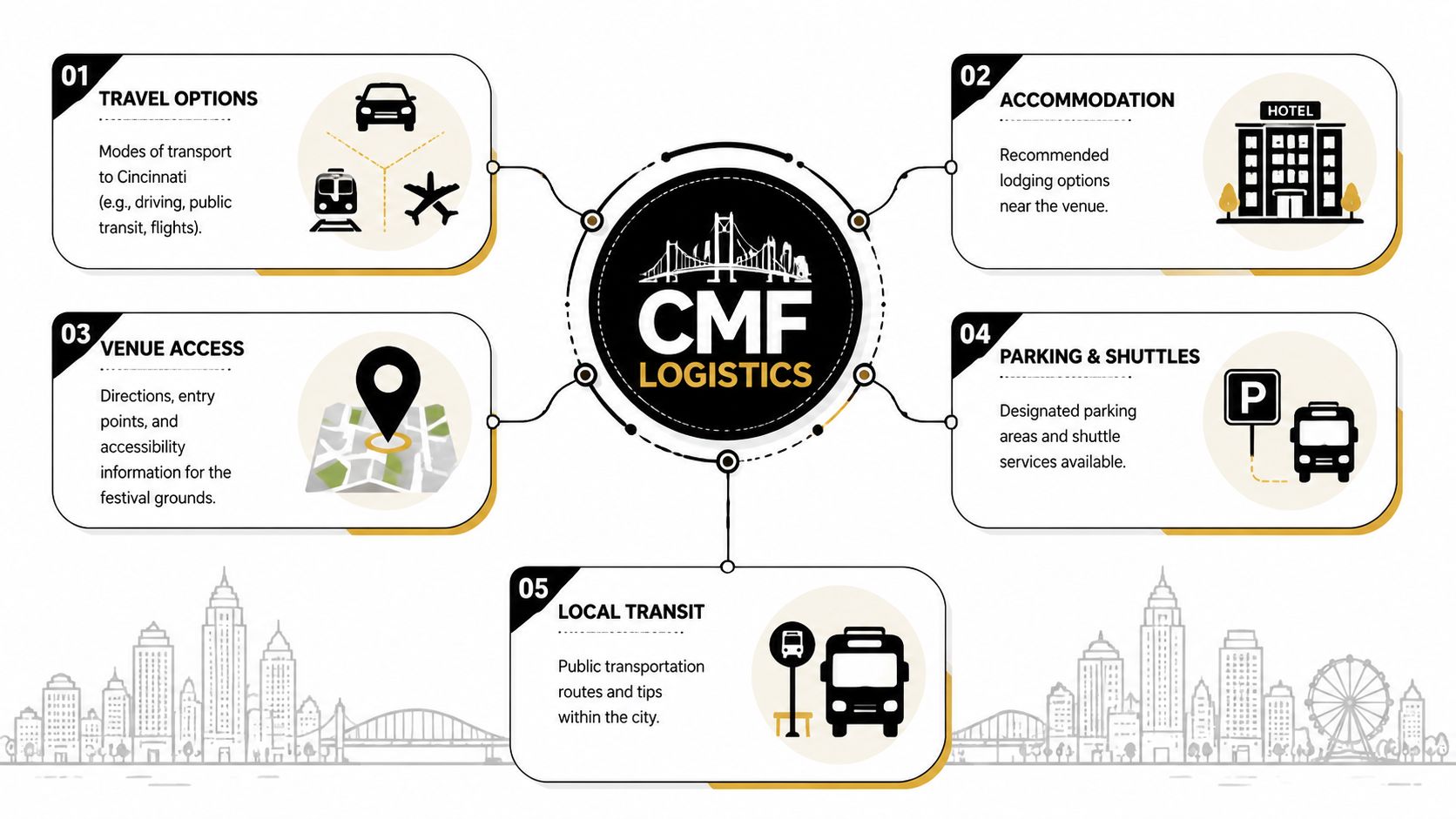
The Cincinnati Music Festival uses downtown streets, stadium access, and surrounding routes in ways that affect everyone, including people who aren't attending. If you treat it like a normal concert arrival, you'll likely waste time.
Street closures change your whole plan
To manage over 100,000 attendees, major street closures on Freedom Way, Race Street, and Central Avenue begin as early as 2 AM, and the city uses a “Bengals game-style” exit protocol to manage traffic flow. Those details come directly from official Cincinnati Music Festival street closure guidance.
That tells you two things immediately.
First, the city plans for movement long before showtime. Second, the exit is engineered, not casual. If you drive in expecting quick freedom after the last act, you're ignoring the operating model.
The smartest ways to arrive and leave
Here's what generally works better than last-minute improvisation:
- Driving with a preselected garage: Best for groups that want control, don't mind a walk, and can leave patiently.
- Rideshare with a planned meetup point away from peak friction: Better than curbside chaos directly beside the venue.
- Walking from a hotel or nearby district: Often the least stressful option if you're staying close enough.
- Public transit when available and familiar: Useful if you're comfortable with local routing and post-show timing.
What usually doesn't work well is trying to get dropped off at the most obvious point near the stadium right before prime arrival windows. Everyone else has the same idea.
A better approach is to think in zones. Don't ask, “How do I get to the gate?” Ask, “How do I get within a manageable walking radius without entering the tightest traffic funnel?”
Accessibility and timing matter together
Accessibility planning shouldn't be treated as an afterthought. Anyone attending with mobility considerations should confirm route practicality well before day-of. The shortest route on a map isn't always the easiest one in a closure-heavy environment.
For groups, assign one logistics lead. Not a dictator. Just one person who knows the arrival window, parking choice, walking route, and fallback plan if phones lag or streets shift.
If you organize events yourself, event logistics planning for high-traffic venues is a useful operational read because it forces the same questions CMF has to solve at scale: arrival sequencing, staff positioning, and controlled exits.
Leave earlier than feels necessary. At major festivals, unused buffer time is harmless. Missing your entry rhythm is not.
Attendee Tips for a Safe and Fun Festival
The best festival nights feel effortless. They aren't. People who stay comfortable for hours usually made good choices before they ever entered the venue.
At the Cincinnati Music Festival, safety planning should be personal, not passive. That's especially true around heat. There's a critical public information gap around official heat management protocols, including no public data on cooling zones or medical response times from previous years, so attendees need to take responsibility for reducing heat-related risk at Paycor Stadium. Heat risk information gap for CMF attendees
Heat planning matters more than people admit
“Bring water” is fine as advice, but it's not enough. Real heat planning starts earlier.
Use a simple personal rule set:
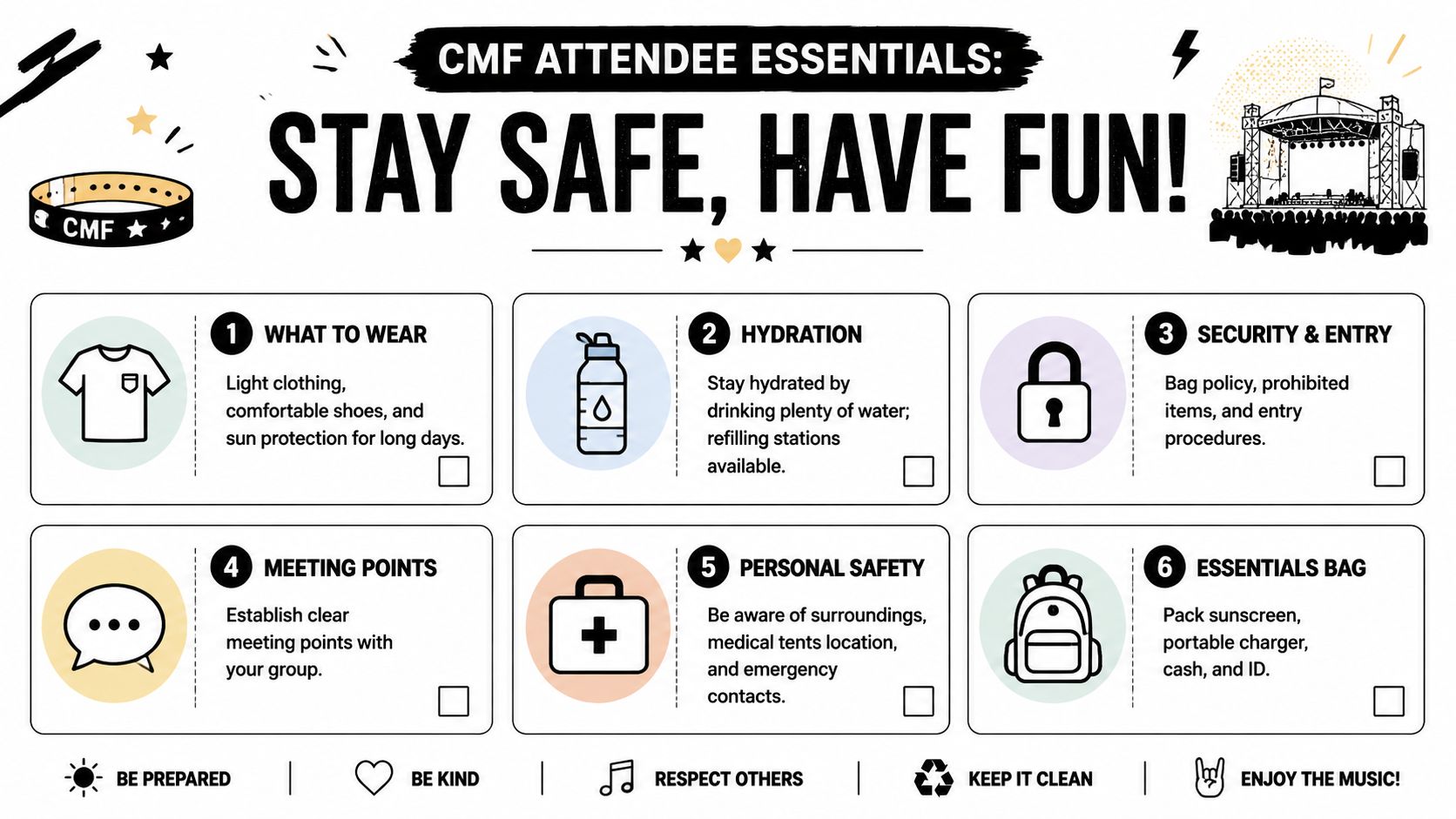
- Dress for standing and walking: Light clothing and shoes you trust matter more than a perfect outfit.
- Arrive already hydrated: Don't wait until you feel drained.
- Know your warning signs: Dizziness, unusual fatigue, nausea, headache, confusion, and chills in heat are all signals to stop and reset.
- Take shade and rest seriously: Short breaks prevent longer problems.
- Watch the quietest person in your group: People often underreport how bad they feel because they don't want to slow everyone down.
If you're attending with older family members, younger guests, or anyone sensitive to heat, make the plan explicit. Pick a regroup point. Decide what happens if someone needs to sit out part of the show. That's not overcautious. That's what smart groups do.
What to bring and how to move through the day
Festival comfort usually comes down to a short list of boring items people regret forgetting.
Bring:
- Phone power: A charged phone and backup battery solve more problems than almost anything else.
- ID and payment basics: Keep them easy to reach and hard to lose.
- Sun protection: Hat, sunscreen, and anything else you know you'll use.
- A compact essentials setup: The smaller and more organized your carry, the easier your entry and movement.
Leave behind anything that creates security friction, bulk, or extra decision-making at the gate. The right bag is the one that gets through quickly and doesn't become annoying by the second hour.
Hygiene also matters more than many people expect at outdoor and stadium events. For a useful operations-minded read on why cleanliness affects comfort, guest perception, and venue flow, I recommend insights from WipesBlog. It's especially relevant if you care about restroom conditions, hand-cleaning habits, and how quickly shared spaces can degrade during long event days.
A few social rules help too:
- Set a meeting point before entry. “Text me when you get out” is not a plan.
- Don't rely on constant phone service. Congestion happens.
- Protect your exit energy. The walk out can be the hardest part of the night if you've emptied the tank inside.
Good festival nights aren't built on toughness. They're built on pacing.
A Guide for Event Organizers Ticketing and Check-In
Large festivals expose every weakness in an event operation. If ticket data is messy, the gate feels it. If access permissions are vague, security improvises. If guest communication is inconsistent, the front-of-house team pays for it.
That's why CMF is useful to event organizers even if you never produce a music festival. The same core questions show up at conferences, graduations, nonprofit galas, and multi-day community events. Who can enter? When? Through which gate or zone? What happens if the signal drops, the attendee name is misspelled, or the pass needs session-specific permissions?
What large festivals teach about access control
The first lesson is that simple lists stop being simple fast. A “guest list” sounds manageable until you add VIP entry, staff credentials, artists, sponsors, media, vendors, multi-day passes, invite-only side events, and restricted backstage zones.
At that point, spreadsheets still work, but only if they're structured for operations instead of just storage. The teams that struggle usually make one of two mistakes:
- They keep attendee data in a static sheet that staff can't validate cleanly at the door.
- They move to a heavy platform that solves every theoretical problem while creating training friction for the actual team.
The middle path is usually stronger. Keep your data in a system staff already understand, but connect it to ticket creation and live validation.
That's where tools like QR code tickets for Google Sheets become practical instead of flashy. They let organizers work inside a familiar sheet while still generating scannable tickets, custom fields, and controlled access logic that front-line teams can use.
A practical workflow that teams can actually run
For multi-day events, the cleanest workflow usually looks like this:
- Build one source of truth: Keep attendee records in a structured sheet with fields for day, zone, role, and any special permissions.
- Generate distinct ticket credentials: Don't make staff interpret vague pass names at the door.
- Distribute digitally with clear instructions: Entry confusion often starts in the inbox, not at the gate.
- Scan at check-in with real-time status updates: Duplicate use and manual overrides become easier to spot.
- Prepare for offline conditions: If connectivity drops, your operation still needs to move.
This approach matters because high-volume check-in is not a branding exercise. It's a throughput exercise. Every extra interpretation step slows lines, increases disputes, and forces staff to make judgment calls that should have been resolved in the data model.
Clean check-in starts with clean permissions. If a scanner operator has to guess, the setup already failed.
Organizers handling music, panel, or hybrid programming should also review licensing early. If your event includes performances, DJ sets, or public playback, the 2026 public performance license guide is a practical reference for the rights side that often gets left too late.
Another lesson from large events is staffing design. The best scan system won't save a poor lane plan. You need enough devices, enough trained people, and a clear rule for exceptions. Decide in advance who handles name mismatches, broken phone screens, guest transfers, and unauthorized access attempts. Your fastest check-in lane is often the one with the fewest edge cases, not the fanciest equipment.
For teams working in Google Workspace, spreadsheet-based ticketing can be especially effective because it reduces retraining. Staff already know how to search rows, update notes, and filter lists. That familiarity matters on event day. The lower the training burden, the more likely the operation holds up under pressure.
Finally, don't separate ticketing from site operations. Ticket structure should mirror venue logic. If the event has multiple zones, sessions, or entry windows, the pass has to reflect that precisely. Otherwise, the gate team ends up translating business rules in real time, which is exactly what you want to avoid.
Experience the Best of Cincinnati Music
The Cincinnati Music Festival rewards people who treat it with respect. Respect for the scale, respect for the city, and respect for the fact that a great weekend usually comes from good preparation. If you're attending, the essentials are straightforward: know your day, plan your route, protect your energy, and don't be casual about heat or group coordination.
What makes CMF stand out isn't only the lineup. It's the way music, memory, and city movement all meet in one place. The weekend carries a cultural weight that a lot of festival guides flatten into a list of artists and parking notes. That misses the point. This is a gathering with history behind it and operational complexity underneath it.
For organizers, that complexity is where the value sits. CMF shows what large events require when the crowd is big, the schedule is layered, and the venue footprint extends beyond a single gate. Ticketing, validation, traffic control, and access permissions aren't side issues. They are the experience.
If you go in ready, the Cincinnati Music Festival can feel smooth, joyful, and worth every bit of the planning it asks for.
If you run events and want a simpler way to manage guest lists, ticket delivery, and door scanning inside tools your team already knows, Darkaa is worth a look. It turns Google Workspace into a practical system for QR code tickets for Google Sheets, QR code attendance for Google Forms, and QR code ticket check-in for Sheets, which is especially useful for multi-day festivals, conferences, school events, and venue operations that need clear access control without a heavy new platform.