You're probably dealing with one of two versions of a neighborhood sale right now. In the first version, neighbors text you at midnight asking if they're “still on the map,” somebody forgets their address, the signs go up late, and buyers drive through once, get confused, and leave. In the second version, sellers know where to set up, shoppers can follow a clear route, volunteers aren't buried in last-minute questions, and the whole event feels less like a scramble and more like a small local tradition.
That difference usually isn't about enthusiasm. It's about systems.
Community garage sales sit in a much bigger resale world than is commonly understood. One retail infographic reports that about 165,000 yard sales happen each week in the United States, drawing roughly 690,000 buyers and generating about $4.22 million in weekly revenue, with an average item price of 85¢ (yard sale economy infographic). That tells you two useful things right away. First, these events are normal, recurring local commerce. Second, the margins on individual items are small, so organization matters more than polish.
If your neighborhood is sorting through what to list, price, or spotlight in ads, it also helps to look at a practical guide on how to maximize resale profits before you build the seller packet. A better item mix won't fix messy logistics, but it does make the event more attractive to buyers.
Table of Contents
- From Clutter to Community Connection
- Phase 1 The Foundation for a Successful Sale
- Phase 2 Streamlining Participant and Vendor Registration
- Phase 3 Creating a Buzz and Driving Foot Traffic
- Phase 4 Designing the Event Layout and Experience
- Phase 5 Mastering Day-Of Operations
- Post-Event Wrap-Up and Building for Next Year
From Clutter to Community Connection
The fastest way to tell whether a community garage sale was planned well is to watch the first hour.
In a rough event, cars slow down at the neighborhood entrance, then hesitate because the signs are inconsistent. A few shoppers stop, but they don't know whether the sale is at one central site or spread across side streets. Half the sellers are still setting up. Two neighbors didn't send their addresses in time, so they aren't on the flyer. Buyers leave with the impression that the event is smaller than it really is.
A well-run event feels different immediately. The entrance signs match. The sale map is easy to scan on a phone. Households with standout items are clearly marked. Volunteers answer the same basic questions with the same answers. Buyers don't need to guess where to go next.
Practical rule: Buyers forgive folding tables and handwritten price tags. They don't forgive confusion.
That's why community garage sales work best when you stop thinking of them as a loose collection of driveways and start treating them like a neighborhood event with a route, a registration process, and a public information system. The social side matters too. People show up to shop, but they also end up chatting with neighbors, walking streets they rarely walk, and seeing the area in a different way.
There's a nice side effect when the logistics are tight. Sellers feel supported instead of abandoned. Volunteers don't spend the morning doing detective work. And the event can grow without becoming harder every year.
Phase 1 The Foundation for a Successful Sale
A strong sale starts long before the first sign goes up. Most problems on event day trace back to decisions that were skipped in the planning stage.
Start with a small organizing core
Keep the planning group lean. For most community garage sales, you need a coordinator, one person handling participant communication, one person managing signs and map details, and one person covering day-of volunteers or check-in. If one person tries to do all four, details slip.
Decide what kind of event you're running. Some neighborhoods want a simple decluttering weekend. Others want a small fundraiser, a traffic-building event for the HOA, or a recurring annual sale that people remember. That choice affects everything from seller expectations to whether you collect fees, print maps, or arrange a central info table.
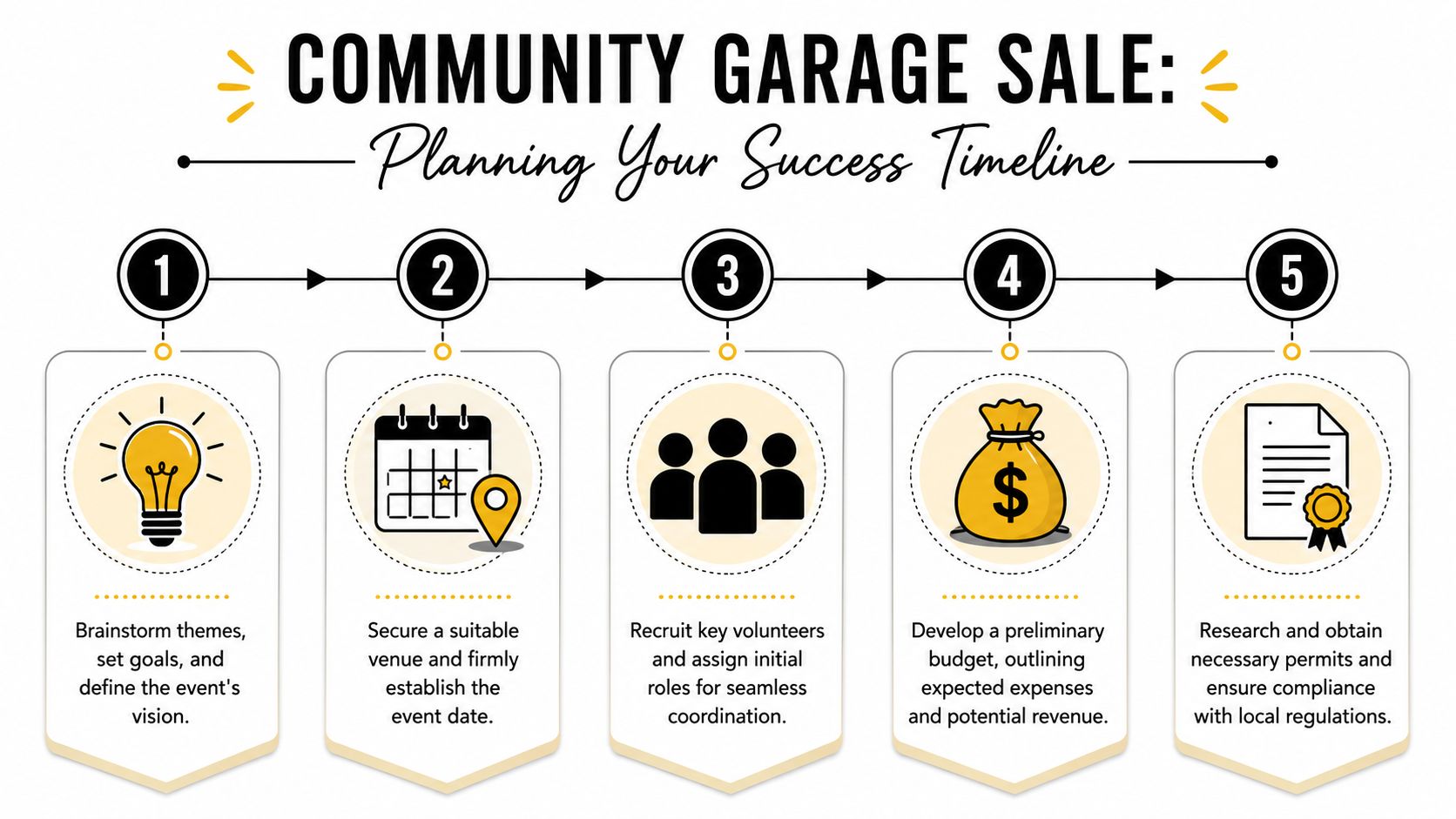
If you want a broader planning framework for neighborhood events, this guide to community event planning ideas and logistics is useful because it pushes you to define roles before promotion starts.
Choose the date before you design anything
Garage sales as we know them are a 20th-century practice, and they're typically held on weekends with good weather at private residences such as a front lawn, patio, garage, or driveway, especially in suburban areas (yard and tag sale background from EBSCO). That old pattern still matters. People expect these events on fair-weather weekends, and they're more likely to browse when the timing feels familiar.
Don't start with the flyer. Start with local constraints.
Use this checklist before you announce a date:
- Check community rules: HOAs, neighborhood associations, or property managers may have restrictions on signs, parking, sale hours, or common-area use.
- Confirm local ordinances: Some municipalities regulate sale frequency, temporary signage, or right-of-way placement.
- Pick a rain approach: Either set a rain date in advance or make it clear whether the event is held rain or shine.
- Match the neighborhood pattern: If your area already has a spring or fall sale tradition, it's easier to build turnout around that expectation.
A beautiful promo graphic won't rescue a date that conflicts with local rules, blocked streets, or a community festival across town.
Set rules early and keep them simple
The sellers' packet should be short enough that people read it. Long documents get ignored. Include only what affects participation and buyer experience.
A simple planning table helps:
| Item | What to decide |
|---|---|
| Participation | Who can join and how they sign up |
| Location model | Individual homes, central lot, or both |
| Seller expectations | Setup time, cleanup, pricing, prohibited items |
| Promotion | What organizers provide versus what each household does |
| Support | Whether there's a central help desk, map, or check-in point |
Budget for the boring items. Signs, tape, printer ink, waiver forms, table rentals if needed, and extra supplies for a central station add up quickly even when the event is modest. The neighborhoods that keep this sustainable are usually the ones that avoid last-minute purchases.
Phase 2 Streamlining Participant and Vendor Registration
The hardest part of scaling community garage sales isn't attracting buyers. It's keeping seller information accurate.
Small events can limp along with texts, email threads, and a paper list. Once the sale spreads across many homes, that setup starts breaking. Addresses arrive in different formats. People forget whether they signed up. Somebody wants to join after the flyer is already done. Another household signs up for one day but not the other. None of that is dramatic by itself. Together, it creates a mess.
Why paper lists break down fast
One neighborhood-sale guide still recommends tracking homeowner names, phone numbers, addresses, and main ticket items in a notebook or document. That works for a few homes, but it becomes a bottleneck at neighborhood scale, especially when events stretch across multiple days or flexible participation windows (manual tracking problem in community sales).
That's the point where organizers start answering the same questions over and over:
- “Did you get my address?”
- “Are we on Saturday only or both days?”
- “Can you add our baby items to the flyer?”
- “Why isn't our house on the map?”
Each question is really a system failure. The fix is to collect structured data once and let that feed everything else.
The simple workflow that scales
Use a Google Form as the front door. Every seller fills out the same fields. Responses flow into Google Sheets automatically. That sheet becomes your single source of truth for the event.
If you've never set this up before, a walkthrough on online event registration with Google Forms and Sheets is a good model because the same structure works for neighborhood sellers, not just formal attendees.
Here's the workflow I'd use every time:
- Create one registration form: Keep required fields limited to what you need for the map, outreach, and day-of verification.
- Feed responses into one master sheet: Don't maintain a separate “cleaned up” list unless someone owns that job and updates it daily.
- Add status columns: Approved, waiting on address confirmation, paid if applicable, one-day or multi-day, featured items, map-ready.
- Lock the public-facing fields: Once map production starts, only edit core address and schedule details in one place.
- Issue participation confirmation: If you want a cleaner process, generate QR code tickets for Google Sheets so each registered household receives a scannable confirmation tied to its row in the sheet.
For organizers who want to stay inside Google Workspace, Darkaa can create one QR code per row or form response, send those passes by email or WhatsApp, and sync scans back to Sheets during check-in. That's useful when you need a simple official roster without building a separate registration system.
The real win isn't the QR code itself. It's having one record per household that stays consistent from signup to event day.
What to collect on the form
Don't ask for everything. Ask for the fields that remove friction later.
A practical seller form usually includes:
- Primary contact name: One person who answers messages.
- Phone or email: Pick the contact method you'll use.
- Sale address: In standard format so you can map it cleanly.
- Participation day: Especially important for multi-day events.
- Main ticket items: Helpful for flyers and route planning.
- Special notes: Gated access, corner house, shared driveway, or other directions.
- Agreement checkbox: Confirms rules, cleanup expectations, and deadline awareness.
Optional fields can create more work than value. If you ask sellers to describe every category they'll offer, you'll spend time cleaning vague answers. Focus on what helps buyers find items and what helps organizers verify.
Phase 3 Creating a Buzz and Driving Foot Traffic
Promotion for community garage sales still starts on the street. People need to know the event exists before they'll care about your online map.

The mistake I see most often is overdesigning the social post and underplanning the physical wayfinding. If your signs are late, small, or vague, the event will feel underattended even if plenty of homes signed up.
Signs still do the heavy lifting
Roadside signs should answer three questions fast: what this is, when it's happening, and where to turn. High contrast matters more than style. Arrows matter more than branding.
A working sign system usually includes:
- Entry signs: At the main roads entering the neighborhood.
- Directional signs: At every confusing turn, not just the first one.
- Confirmation signs: Short reassurance markers that tell drivers they're still on the correct route.
- Seller markers: House-level signs or balloons so shoppers don't miss participating homes.
If you want extra ideas for presentation and messaging, this piece on Professional garage sale marketing from DIYAuctions has useful examples of what makes promotions easier to notice.
Build one public map and share that everywhere
Your Google Sheet already has the addresses. Use that data to build one public-facing Google Map. That map becomes the centerpiece of your buyer communication.
Include only buyer-friendly details:
| Map field | Why it helps |
|---|---|
| Address | Core navigation |
| Participation day | Prevents wasted stops |
| Main ticket items | Helps shoppers prioritize |
| Landmark note | Useful for hard-to-find homes |
Once the map exists, stop creating multiple versions of the same information. The flyer, Facebook post, neighborhood email, and printed handout should all point to the same map. That avoids the classic problem where one seller is listed differently in three places.
When buyers ask where to start, give them one answer. A clear route beats a long description every time.
Add a QR code to printed signs or flyers that opens the live map. That small move connects your street-level promotion with your digital planning work and cuts down on day-of confusion.
A short demo can help if your team wants to see how video-based promotion and public sharing fit into event outreach:
Use digital channels to reduce repeat questions
Facebook Events and Nextdoor are useful because they collect local attention in one place. Use them for updates, seller highlights, and reminders about date and start time. Don't bury important details in comment threads. Put the map link and the basics in the event description, then repeat them in updates as needed.
Good digital promotion doesn't try to say everything. It tries to reduce repeated questions. If buyers can quickly see the date, neighborhood entry points, and map link, your messages become lighter and your volunteers spend less time answering the same texts.
Phase 4 Designing the Event Layout and Experience
Layout decisions depend on which kind of sale you're running. A central parking-lot sale and a neighborhood-wide driveway sale may share a name, but they behave like different event types.
Single-location sales need flow control
A central location creates convenience, but it also concentrates every problem. Parking, bottlenecks, stroller movement, and checkout lines all show up in the same place.
For a single-site setup, think in zones:
- Arrival zone: Clear entrance, parking guidance, and a visible welcome point.
- Browsing lanes: Wide enough that people can stop without blocking others.
- Heavy-item area: Furniture, tools, and bulkier goods near vehicle access.
- Checkout point: Easy to find, staffed, and away from the busiest browsing aisle.
The trade-off is simple. Centralized sales are easier to supervise, but they demand stronger traffic control. If tables are packed too tightly, shoppers rush instead of browsing. If parking isn't designated, nearby residents get frustrated quickly.
Neighborhood-wide sales need navigation control
Distributed community garage sales have the opposite problem. Parking pressure spreads out, but confusion spreads out too.
The priority here is route clarity. Buyers need to know where to enter the neighborhood, how to move through it without doubling back, and which homes are participating that day. A digital map solves part of that. Physical cues finish the job.
Use a few practical standards:
- Place the first sign before the first turn: Drivers decide fast.
- Mark participating homes consistently: Same color sign, same basic format.
- Use QR codes on central posters: Let buyers open the live map without typing.
- Think about accessibility: Avoid forcing long walks from parking to clusters if you can identify easier access points.
A neighborhood-wide sale usually feels more pleasant when shoppers can move at their own pace, but only if the route feels intentional. Otherwise, buyers assume the event is disorganized and skip the side streets where some of the best sellers are set up.
Phase 5 Mastering Day-Of Operations
The morning of the sale is where good planning starts paying rent. If the prep was solid, event day feels busy but manageable. If the prep was loose, the first hour turns into triage.

A practical benchmark is to run the sale on Saturday or Sunday starting at 8 to 9 a.m., and for larger neighborhood events, set the participation deadline about one week before so the map, signs, and advertising are finalized (garage sale timing and participation deadline guidance). That timing works because it catches early shoppers while giving households enough lead time to finish setup.
Open early and remove friction
The best event-day setup is boring in the best way. Everyone knows where to go. Every essential tool is already in place. Nobody is hunting for tape, cash, or extension cords at opening time.
At minimum, the organizer's station should have:
- Change and small bills: Sellers always ask for backup.
- Printed roster: Useful when a phone battery dies.
- Charged phones and battery packs: Maps, messages, and check-in all depend on them.
- Calculator, pens, tape, and extra signs: These disappear quickly.
- Reusable bags: Buyers often carry more when it's easy.
- Access to an outlet: Helpful for testing electronics.
The first visible mistake to avoid is delayed setup. The second is unpriced inventory. Buyers drift away when they have to ask about every item, especially in a neighborhood sale with many stops.
Use check-in to keep the official map accurate
For larger events, I like a quick seller confirmation step before or during setup. It doesn't need to feel formal. It just needs to confirm that the household is participating and that the public list is still accurate.
A simple system is to send each registered seller a scannable confirmation and validate it on arrival or when volunteers do a quick round. A QR code ticket check-in for Sheets workflow works well here because each scan ties back to a row in the roster and records who showed up. If your team wants a setup pattern, this guide on using a QR code for event check-in and attendance tracking matches the same operational idea.
If a seller no-shows but stays on the public map, buyers experience that as broken trust. Clean check-in prevents that.
This also helps when the event spans multiple days. You can verify who's active on a given morning instead of relying on a static list created days earlier.
Keep volunteers focused on visible problems
Volunteer jobs should be narrow. Broad instructions create hesitation.
A practical split looks like this:
| Role | Main job |
|---|---|
| Entrance volunteer | Watch signs, answer arrival questions |
| Float volunteer | Replace missing signs, solve simple issues |
| Check-in volunteer | Confirm participating households |
| Info desk volunteer | Handle map questions and lost-and-found style issues |
Teach volunteers to fix what buyers can see first. Missing turn signs, blocked driveways, and unclear seller locations damage the experience faster than back-end admin problems. Most shoppers won't notice your spreadsheet. They will notice a dead-end route and an unmarked house.
Post-Event Wrap-Up and Building for Next Year
The event isn't finished when the last buyer leaves. The final hour and the next day determine whether the sale becomes easier to run next year or starts from scratch again.
Close the loop while details are fresh
Start with cleanup and reconciliation. Collect leftover signs, close out any shared cash handling, and note which homes participated as planned versus which ones dropped late or changed details. That record matters more than memory.
Then send one short follow-up form to participants. Google Forms is enough. Ask what worked, what caused friction, and whether they'd join again. Keep the survey brief so people answer while the morning is still fresh in their minds.
If sellers have leftovers they don't want to store, include a practical option for what to do next. This guide to donating items to Goodwill is a useful handoff because many households are deciding that same day whether to repost, keep, or donate.
Turn this year's notes into next year's template
The strongest annual community garage sales don't rely on institutional memory. They keep a reusable package.
Save these items in one shared folder:
- Final seller form
- Master spreadsheet
- Public map template
- Sign designs
- Seller instruction sheet
- Post-event survey
- Short debrief notes
That folder becomes the operating system for next year. You won't need to reinvent the process, and new volunteers can step in without starting cold.
A neighborhood sale does more than move unwanted items. It gives people a reason to coordinate, meet, and contribute to something visible together. When the process is simple and repeatable, the event feels less like extra work and more like part of the neighborhood calendar.
If you want to run community garage sales with less manual follow-up, Darkaa is worth a look. It works inside Google Forms and Google Sheets, so you can collect seller signups, generate QR-based confirmations, and check participants in without moving your roster into a separate event platform.